
We’ve all been there. Staring at a flat-pack bookshelf that costs less than a decent dinner out. Convincing ourselves that “it’ll do for now.” It looks harmless enough on the showroom floor or in a pristine online photo. But fast furniture has a quiet, insidious way of draining your wallet. As well as cluttering your life, long after the initial dopamine hit of a bargain fades.
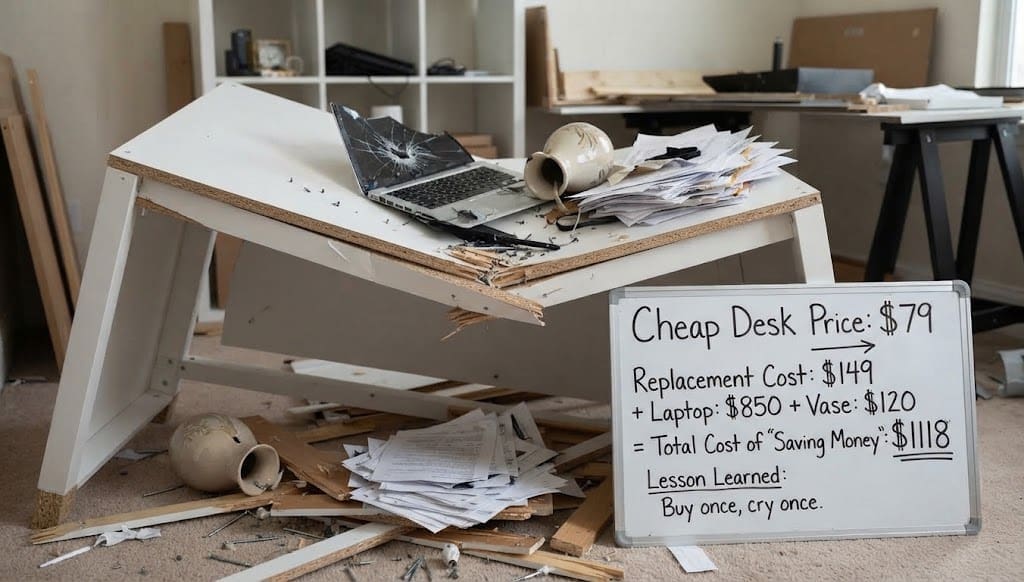
The illusion of savings is the first trap. When you buy a particleboard dresser or a hollow-core desk, you aren’t actually investing in a piece of furniture. You’re buying a temporary placeholder. Within a year or two—sometimes sooner if you dare to move home—the structural integrity gives way. Screws strip out of compressed sawdust, drawers sag off their tracks. Wobbly legs turn every coffee cup placement into a game of high-stakes roulette. Suddenly, you find yourself replacing that cheap nightstand yet again. Over a decade, buying disposable items repeatedly adds up. It costs far more than the cost of a single, solidly crafted wooden piece that could have lasted a lifetime.
Beyond the financial sting, there is the staggering environmental toll. The disposable furniture industry operates on a relentless cycle of extraction, manufacturing and discarding. Because these items are difficult or impossible to repair. Glued joints snap, laminate peels and low-grade materials degrade. They’re made overseas yet they end up in Canadian landfills by the millions. Particleboard is notoriously tricky to recycle because of the heavy resins and adhesives used to bind it together. Meaning your temporary bargain transforms into permanent environmental waste.

There is also the hidden cost to your peace of mind and home aesthetic. Well-crafted furniture anchors a room, gaining character and a rich patina as it ages. Disposable furniture does the opposite. It looks tired within months, dragging down the visual energy of your entire home. Making your living space feel perpetually unsettled and temporary.
Breaking the cycle requires a shift in mindset. It means viewing furniture not as a disposable commodity, but as an enduring component of your daily life. Buying quality doesn’t always require breaking the bank (particularly when shopping at L Furniture!). Supporting local Canadian craftsmanship or simply saving up for one foundational piece changes the math entirely. When you stop paying for cheap items over and over again, you realize that true value isn’t found in the lowest price. But in the things you never have to replace.