Why Solid Wood and Plywood Make the Ultimate Bookshelf
When you are investing in a bookshelf, you want a piece of furniture that can handle heavy loads. But you also want it to anchor your room aesthetically and stand the test of time. If you have ever browsed mass-market furniture retailers, you have likely encountered disposable, lightweight, particle-board shelves that sag under the weight of a few heavy hardcovers. Shelving that will not take dismantling or chips each time you look at it.
On the other hand, purists often praise “100% solid wood”. But when it comes to larger shelving units, solid wood alone has distinct structural drawbacks.
The Flaw in “Pure Solid Wood” for Large Shelves
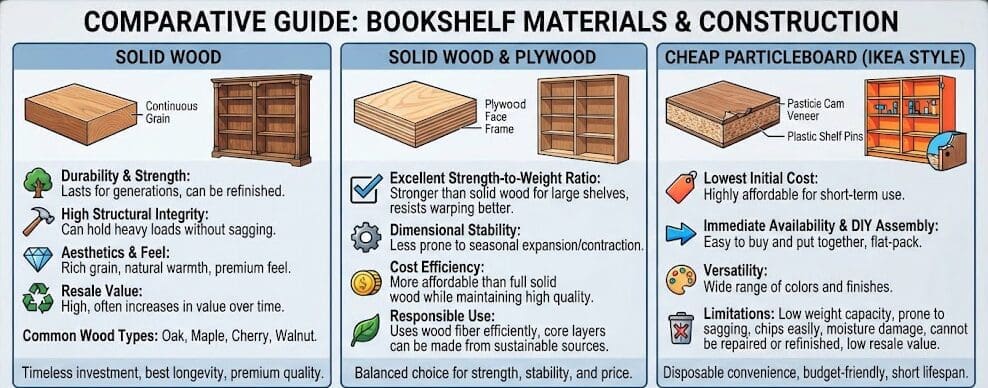
While solid wood is undeniably beautiful and durable, it is also a natural, living material. Wood expands and contracts with changes in humidity and temperature.
For small furniture items, solid wood works wonderfully. However, when used for larger shelves and wide spans, pure solid wood is prone to two major issues:
- Warping and Cupping: As seasonal humidity shifts, wide boards of solid wood tend to twist, bow or cup. A solid wood shelf that starts flat can warp over time. Causing books to slide or the frame to skew. This problem is particularly severe in Canada. As we go from hot summers and then into warm, dry air heated homes to combat our severe winters.
- Sagging Under Load: Solid wood can lack the cross-directional rigidity required to span wide shelves. Eventually bowing in the middle under heavy book loads.
Why Plywood is the Secret to Structural Integrity for a bookshelf
Engineering matters. High grade plywood is manufactured by cross-laminating thin layers of wood veneer under intense heat and pressure. This cross grain construction creates a board that pulls equally in all directions. Thereby completely neutralizing the natural tendency of wood to warp.
- Dimensional Stability: Unlike solid wood, premium plywood will not warp, cup or twist with seasonal humidity changes. It stays completely flat and true.
- Exceptional Strength-to-Weight Ratio: Plywood provides incredible rigidity and load-bearing capacity. Making it the ideal material for wide shelves that need to hold heavy rows of books without sagging.
The Disposable Furniture Problem: Particle Board and Paper Honeycomb
Mass produced, disposable furniture relies almost entirely on particle board, medium density fibre board (MDF), or even hollow cardboard honeycomb structures wrapped in a thin laminate veneer.
- Fragile Connections: Once you assemble a flat-pack bookshelf, the screws bite into compressed wood chips. If you ever need to move or disassemble the unit, those holes strip easily rendering the furniture useless / unstable.
- Moisture Vulnerability: If a flat-pack shelf gets exposed to the smallest amount of moisture, the particle board swells like a sponge and permanently disintegrates. Along with your money that you wasted.

The L Furniture Difference
At L Furniture we combine the best of both worlds. We utilize beautiful, durable solid wood for frames, trim and visible components. Where its natural grain shines, paired with high-performance structural plywood for large shelving panels.
This thoughtful hybrid approach ensures:
- Zero Warping: Your shelves remain perfectly straight and stable year after year, regardless of indoor / outdoor climate shifts.
- Heavy-Duty Capacity: You can stack your favourite heavy volumes, textbooks and decor pieces with total peace of mind. NO sagging allowed!
- Lasting Craftsmanship: Built to be an heirloom piece rather than temporary setup that ends up in a Canadian landfill.
Ready to upgrade your space with furniture built to last a lifetime? Explore our collection at L Furniture and experience the difference true Canadian quality craftsmanship makes.